Pibamarmi.
Innovation and sustainability

Pibamarmi was founded in Chiampo in 1967 by a group of eight workers who initially focused mainly on the production of stone flooring. The company grew rapidly and, in the early 1990s, began exporting to Central and Northern Europe. Today, Pibamarmi has over thirty employees and its sales network covers all areas of the global market. Sales are largely managed through direct contact, ensuring that customers receive specific and ongoing attention.
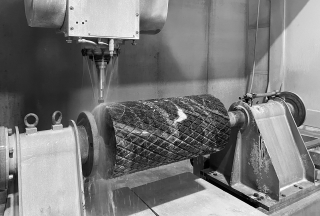
The first CNC (Computer Numerical Control) machine was installed at the Pibamarmi factory in 1996: a four-axis Brembana machining centre, which marked the first step in a series of investments in machinery designed to ensure ever-increasing production speed and precision over the years. The company has always kept pace with technological innovation and today boasts a machine fleet comprising single-blade and multi-blade frames, CNC machining centres and milling machines, waterjet cutting machines, as well as sanders, end-trimming machines and edging machines.


he innovation and quality of Pibamarmi’s stone projects and products have been recognised on several occasions with prestigious international awards, such as the Best Communicator Award (awarded on multiple occasions between 2008 and 2016), established by the Marmomac trade fair in Verona to honour the best corporate displays; the ADI Design Index 2018 selection; and the Wallpaper* Design Award 2019.
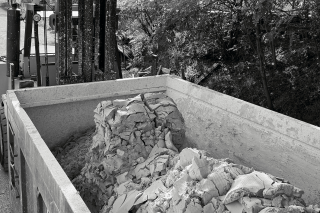
In 2010, Pibamarmi took a significant step towards the environmental sustainability of its production processes: a new sludge filtration system was installed to collect and recover the mixture of water and dust produced during the stone cutting and finishing stages. The water can thus be recycled to reduce water consumption, whilst the sludge, once dried, can be reused in construction or agriculture. By 2024, the plant had processed over 670 tonnes of sludge.
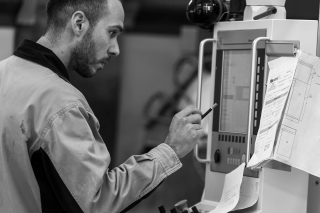
Pibamarmi’s longstanding commitment to innovation is once again evident in 2021 with the introduction of monitoring and automation processes within the context of Industry 4.0. The company’s production lines are networked using MES (Manufacturing Execution System) software, a key tool for businesses seeking to plan and optimise production by monitoring performance, quality and consumption.

Sustainability, in terms of the environmental, social and ethical impact of production, has long been a key priority for Pibamarmi, which in the 2000s promoted specific initiatives aimed at energy saving, reducing emissions and implementing corporate welfare schemes. 2023 saw further significant achievements in this regard, with the installation of a 180 kW photovoltaic system and the award of the Ecovadis Sustainability Rating medal, with particular strengths in the areas of the environment, labour practices and human rights.